
How to Generate Leads Online for a Small Business
Getting people to notice your business is only the first step. The bigger challenge is turning that attention into genuine enquiries, consultations, bookings, or sales.
You might receive social media likes but very few messages. Your website may attract visitors without generating enquiries. Or your advertisements might bring clicks without attracting customers who are ready to buy.
These situations highlight why lead generation for small businesses requires more than visibility. You need a clear offer, a way for interested people to contact you, and a process for converting enquiries into customers.
To understand how lead generation fits into your wider marketing efforts, explore my guide to digital marketing strategies for small businesses.
HubSpot’s guide to marketing your business to Generate Leads discusses approaches including targeted advertising, forms, landing pages, social media, and marketing emails. Let’s explore how small businesses in India can put these principles into practice.
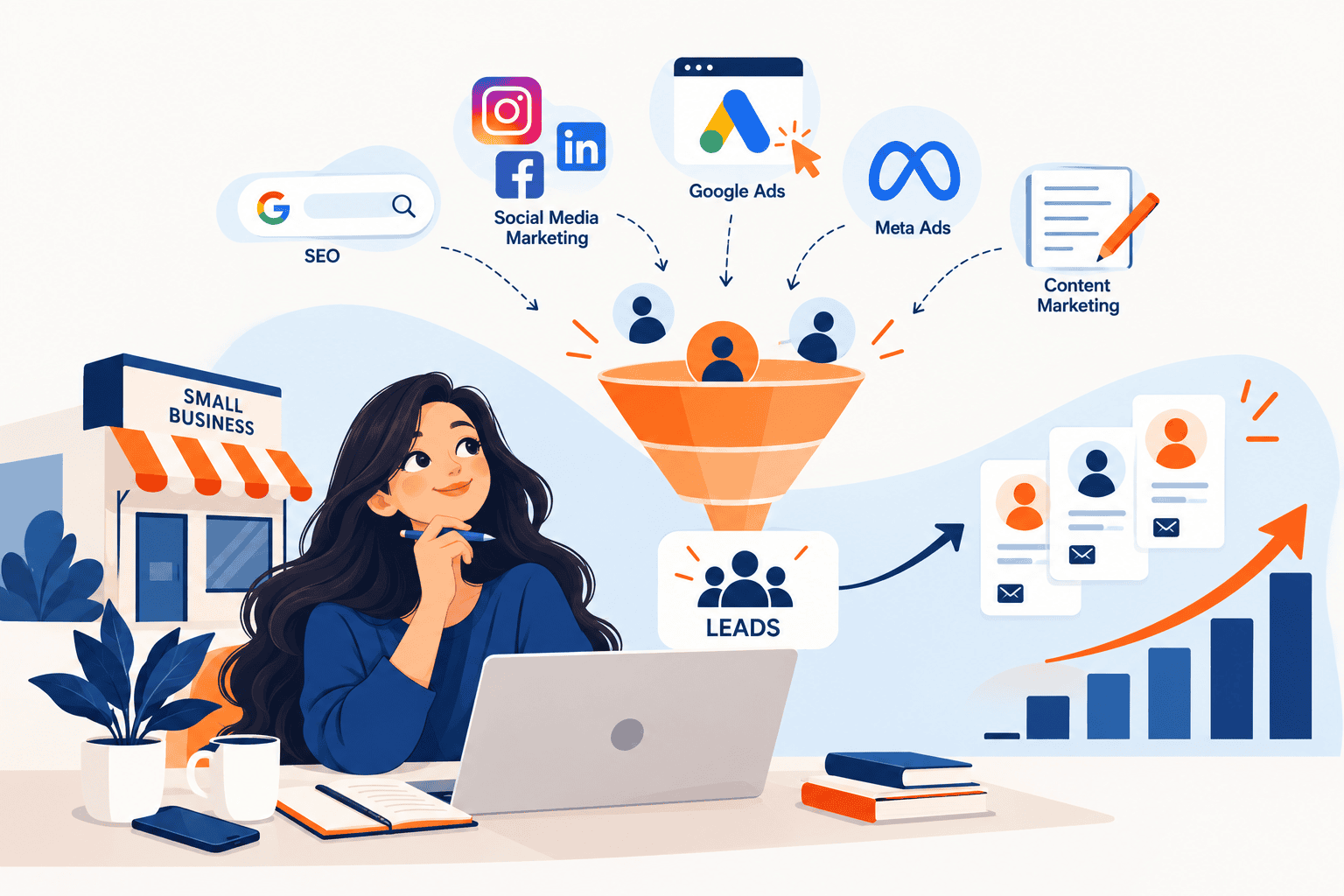
1. Define What a Qualified Lead Looks Like
Before choosing lead generation tactics, determine what makes an enquiry valuable to your business.
For a freelance digital marketer, a qualified lead might be a business owner who needs SEO or performance marketing services, has a relevant project, and is ready to discuss scope and budget.
For a home-based bakery, it could be someone enquiring about a customised cake for a specific date.
Define the information you need to understand whether an enquiry is a good fit. Depending on your business, this could include the customer’s requirements, location, preferred timeline, and budget range.
Avoid focusing entirely on the number of leads. A smaller number of relevant enquiries may be more valuable than a large number of enquiries that cannot convert.
2. Optimise Your Website for Enquiries
Your website should make it easy for visitors to understand your offer and take the next step.
Start with these improvements:
- Explain your service or product clearly.
- Include a visible call to action.
- Provide an easy-to-use contact form.
- Display relevant testimonials or genuine portfolio examples.
- Make contact information easy to find.
- Ensure the website works well on mobile devices.
For example, a digital marketing consultant could create a dedicated SEO services page explaining the problems addressed, the process, deliverables, and how to request a consultation.
Avoid making the visitor search through several pages just to understand what you offer. If you need help improving your website’s organic visibility, explore my digital marketing services for information about SEO and related marketing support.
3. Use SEO to Attract People Searching for Solutions
SEO can help your business reach people who are actively looking for information or services related to your offering.
Suppose you provide digital marketing services to small businesses. You could create useful pages targeting relevant service searches and publish articles answering questions about website visibility, marketing budgets, and lead generation.
Google’s SEO Starter Guide explains how search optimisation helps search engines understand website content and helps users decide which results are relevant to them.
For local businesses, a properly maintained Google Business Profile can also support discovery through Google Search and Maps.
Remember that not every visitor is ready to purchase. Some need information first, while others are comparing providers. Create content that serves both needs and guide readers towards relevant service pages when appropriate.
For more guidance on selecting suitable channels, read my article on the best digital marketing channels for small businesses in India.
4. Create Useful Content That Encourages Enquiries
Content marketing can help potential customers understand their problems and evaluate your expertise.
Consider these examples:
- A digital marketing consultant publishes a checklist for improving website SEO.
- A wedding photographer shares a guide to planning a photoshoot.
- A home baker explains how to select a cake size for an event.
- A business consultant publishes a guide to preparing for a consultation.
Useful content attracts attention while giving readers a reason to trust your business.
Include a relevant next step. An educational article could invite readers to explore a service, download a useful resource, or enquire about a consultation.
Avoid making every article a sales pitch. The call to action should match the reader’s needs and the subject of the content.
If you are planning content for your business, my guide on how to create a digital marketing strategy for a small business explains how to align content, channels, and marketing goals.
5. Use Social Media to Turn Attention Into Leads
Social media can help potential customers discover your business and learn more about your products or services.
To support lead generation, combine educational posts with demonstrations, genuine customer feedback, frequently asked questions, and clear offers.
For instance, a freelance digital marketer could share an example of an SEO audit, explain a common website problem, and invite businesses to enquire about a website review.
A home-based business could showcase its products, explain customisation options, and direct interested customers to a suitable enquiry channel.
Make sure your profile includes the information customers need to take action. Depending on the business, that could be a website link, contact details, booking information, or a clear description of how to place an order.
6. Test Paid Advertising With a Clear Conversion Goal
Google Ads and Meta Ads can help businesses reach relevant audiences, but advertising should be connected to a defined business objective.
Google Search campaigns may suit people actively searching for a particular service. Meta Ads may be useful for introducing offers, promoting products, or generating enquiries from relevant audiences.
Before spending money, confirm that you have:
- A specific audience and offer.
- A relevant landing page or enquiry destination.
- Working conversion tracking.
- A controlled test budget.
- A process for responding to incoming leads.
Track cost per lead and, where possible, cost per acquired customer. Also assess whether the leads are relevant and whether they eventually become paying customers.
Do not increase spending simply because a campaign produces many clicks. Improve the offer, landing page, targeting, or follow-up process if the resulting enquiries are not valuable.
If you are launching a new business and need to keep costs under control, read my guide on how to market a startup with a limited budget.
7. Follow Up With Leads Consistently
Generating an enquiry is not the end of the process. Prospective customers may need clarification, additional information, or time to make a decision.
Create a simple follow-up system:
- Record incoming enquiries in a spreadsheet or CRM.
- Note the customer’s requirement and preferred contact method.
- Respond within a reasonable timeframe.
- Provide relevant information or the next step.
- Follow up appropriately if the person has not responded.
- Record whether the enquiry converted.
For ongoing email or WhatsApp marketing, obtain appropriate consent and respect communication preferences.
A consistent follow-up process can help you identify where prospects lose interest and improve the customer experience.
8. Measure Your Lead Generation Performance
Use a small set of metrics to understand whether your efforts are producing business results.
| Metric | What it tells you |
|---|---|
| Qualified leads | How many relevant prospects enquire |
| Conversion rate | What proportion of visitors or leads take the desired action |
| Cost per lead | How much you spend to generate an enquiry |
| Lead-to-customer rate | What proportion of leads become customers |
| Customer acquisition cost | How much it costs to acquire a customer |
| Revenue generated | Whether marketing contributes to business income |
For example, if your website attracts visitors but few people enquire, review the clarity of your offer, page content, contact process, and audience relevance.
If enquiries are frequent but sales are low, investigate lead quality, pricing, response times, and how well your service matches customer needs.
Final Thoughts
Effective lead generation for a small business starts with understanding your customers and making it easy for interested people to take action.
Combine a useful website, relevant SEO content, appropriate social media activity, and carefully measured advertising where suitable. Then build a consistent follow-up process and evaluate results using qualified leads and actual sales—not visibility alone.
Looking to attract more relevant business enquiries? Explore my digital marketing services to discover how SEO, content marketing, social media, performance marketing, and conversion-focused strategy can support your business growth.